I read this short article by Melanie Curtin this evening and knew immediately it was worth sharing here. The article discusses the results of a 75-year Harvard study and what it revealed about leading a fulfilling life. I believe it has many applications at work and home.
This 75-Year Harvard Study Found the 1 Secret to Leading a Fulfilling Life
Here's some wisdom gleaned from one of the longest longitudinal studies ever conducted.
For over 75 years, Harvard's Grant and Glueck study has tracked the physical and emotional well-being of two populations: 456 poor men growing up in Boston from 1939 to 2014 (the Grant Study), and 268 male graduates from Harvard's classes of 1939-1944 (the Glueck study).
Due to the length of the research period, this has required multiple generations of researchers. Since before WWII, they've diligently analyzed blood samples, conducted brain scans (once they became available), and pored over self-reported surveys, as well as actual interactions with these men, to compile the findings.
The conclusion? According to Robert Waldinger, director of the Harvard Study of Adult Development, one thing surpasses all the rest in terms of importance:
"The clearest message that we get from this 75-year study is this: Good relationships keep us happier and healthier. Period."
Not how much is in your 401(k). Not how many conferences you spoke at--or keynoted. Not how many blog posts you wrote or how many followers you had or how many tech companies you worked for or how much power you wielded there or how much you vested at each.
No, the biggest predictor of your happiness and fulfillment overall in life is, basically, love.
Specifically, the study demonstrates that having someone to rely on helps your nervous system relax, helps your brain stay healthier for longer, and reduces both emotional as well as physical pain.
The data is also very clear that those who feel lonely are more likely to see their physical health decline earlier and die younger.
"It's not just the number of friends you have, and it's not whether or not you're in a committed relationship," says Waldinger. "It's the quality of your close relationships that matters."
What that means is this: It doesn't matter whether you have a huge group of friends and go out every weekend or if you're in a "perfect" romantic relationship (as if those exist). It's the quality of the relationships--how much vulnerability and depth exists within them; how safe you feel sharing with one another; the extent to which you can relax and be seen for who you truly are, and truly see another.
According to George Vaillant, the Harvard psychiatrist who directed the study from 1972 to 2004, there are two foundational elements to this: "One is love. The other is finding a way of coping with life that does not push love away."
Thus, if you've found love (in the form of a relationship, let's say) but you undergo a trauma like losing a job, losing a parent, or losing a child, and you don't deal with that trauma, you could end up "coping" in a way that pushes love away.
This is a very good reminder to prioritize not only connection but your own capacity to process emotions and stress. If you're struggling, get a good therapist. Join a support group. Invest in a workshop. Get a grief counselor. Take personal growth seriously so you are available for connection.
Because the data is clear that, in the end, you could have all the money you've ever wanted, a successful career, and be in good physical health, but without loving relationships, you won't be happy.
The next time you're scrolling through Facebook instead of being present at the table with your significant other, or you're considering staying late at the office instead of getting together with your close friend, or you catch yourself working on a Saturday instead of going to the farmer's market with your sister, consider making a different choice.
"Relationships are messy and they're complicated," acknowledges Waldinger. But he's adamant in his research-backed assessment:
"The good life is built with good relationships."
The Trust Factor
Last week I had the privilege of co-presenting at the Oregon IntegratED conference in Portland, Oregon, sharing with districts around the state how we have been thinking differently about professional development for teachers and administrators; we spent a good portion of the presentation having the audience experience what it feels like to build trust in the context of a collective "WHY". Many of the principles we talked about come from a great short video which I have posted below. Additionally, I've added a few key points as to why this work is so important to effecting great outcomes for students at scale.
- Without trust the work cannot be done effectively together; in fact, without trusting relationships people hunker down and do the work alone because it's safe! This is a survival strategy not an effective strategy. Our job as educators is much too big for any one of us to do it effectively alone! If we want to ensure great outcomes for kids - at scale - we must come together in powerful ways as we will need everyone's best efforts and supporting relationships to get the work done. "People follow leaders by choice. Without trust, at best you get compliance." Lyn
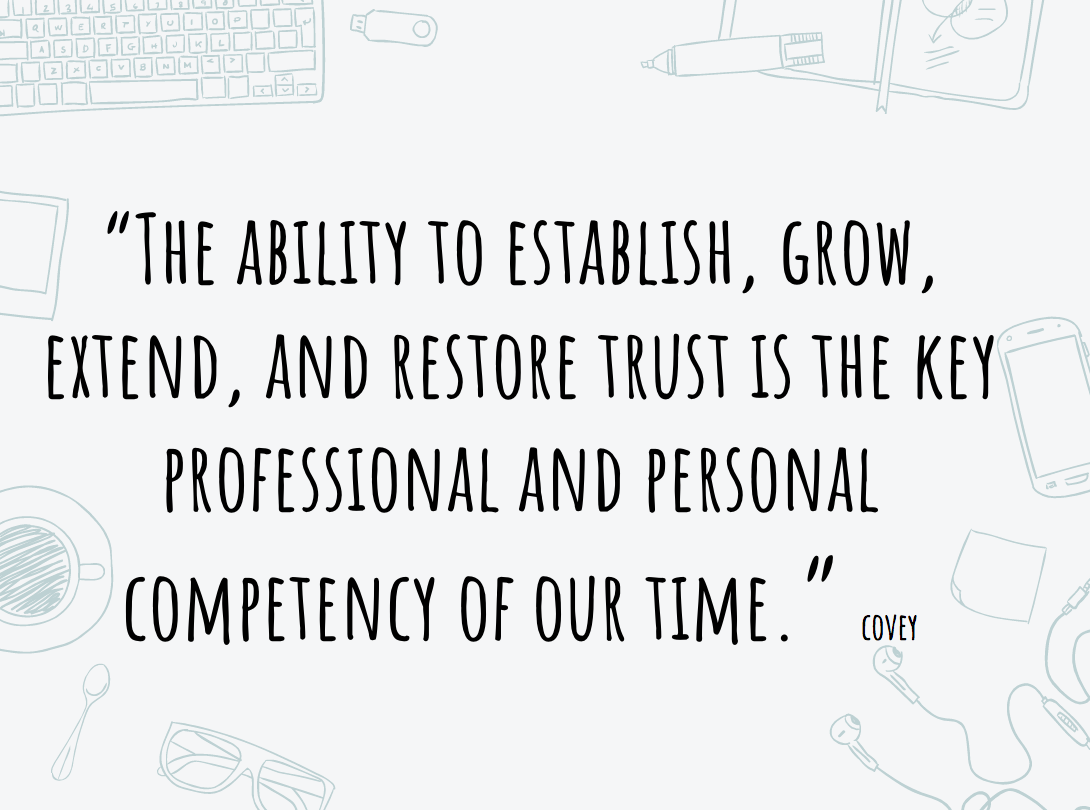
- Trust, contrary to some belief systems, can be built, and effective leaders are constantly looking for ways to build trust in and between people in their organization. To no one's surprise, trust is built through relationships, which is why it is so important to be purposeful about how we spend our time. In that vein, professional development is one key resource to purposefully work on building relationships and trust in our schools and districts.
- We are working to design professional development so that our educators can get to know one another within the meaningful context of our work. In essence, we are designing opportunities for educators to come together to build trust by literally overcoming obstacles and barriers together. If we think of our work in this way it opens the doors for us to be more effective, together.
The following conditions allow everyone to do their most courageous thinking together.
- Every member has value
- Equity of voice, no one member dominates
- Honesty/candor is safe and welcome
- Each member works to bring out the best in others
- Members show a high degree of empathy for each other
- Members are good at giving and getting help
- Members are motivated by the bonds, trust, and openness they develop between each other
Leading Learning

WHY: everything matters but some things just matter more
What is often overlooked in our work is the lift needed to shift the work of leadership from management and accountability to capacity and motivation. Fullan explains it this way: "Capacity building is to accountability what finance is to accounting. Finance is about how people organize and invest their assets; if you have only accounting, you are merely keeping careful records while you go out of business! In the same way, there is more to accountability than measuring results. We must focus our best efforts to develop people's capacity to achieve the results. Extreme pressure without capacity results in dysfunctional behavior."
If we are going to make great gains in education on the behalf of students and families then we must begin to provide leadership that recognizes the power of collective buy-in, shared beliefs and our core values must be the driving force behind our work. What matters most aren't the outputs, but rather the inputs. Let me share a simple example. During dinner time at our house we have plenty of outputs and expectations. My three fun and rudy children, ages 2, 5 and 8 know these rules quite well: No throwing food, no getting out of your seat until you are excused, always say please and thank you, no screaming, no complaining, and always, always eat your vegetables. What I have found over many failed attempts to enforce these rules is that no matter how clear the expectations are, it's actually not the expectations that make the difference during dinner; what makes the most difference are the delicate conditions my wife and I create to ensure our kids have every chance to have a successful dining experience! I can equate this to our work because for the past 15 years in education we have put too much emphasis on our collective expectations rather than on our collective inputs, and values. I would argue that the expectations are the simplest part of the equation, and it's really the inputs and conditions we create that allow for the greatest chances for every student's success.
WHAT: creating conditions of creativity and innovation
What is motivating to our teachers, students and parents? How can we create energy and momentum to build a culture for learning that is tangible within our schools? Just recently Education Week published a body of research against the question that was posed: "How should the public determine if schools are doing their jobs?" The Gallop poll revealed what we would have predicted; parents ranked student engagement as the top priority, followed by students being hopeful about their future. Coming in last place was achievement on state assessments. This is not news to us as educational leaders, as many of us would have guessed that state assessments would rank lowest in the poll. However, the new challenge for us is to shift from a predominantly accountability focused institution to one that prioritizes innovation, creativity, student engagement, hope and well being. It's clear that with the infusion of technology and the free access of information, parents will increasingly, and rightfully demand something different from schools. We must begin to ask ourselves a more complex question: "How do we motivate our staff and students to engage in a new set of realities?"
Our work in education is to tackle this challenge by first leading with a genuine eye on the reality that we must create conditions of innovation, creativity and engagement within our schools. When students are engaged, hopeful and connected results will follow naturally.
HOW: the work was never meant to be done alone, learning is accelerated by the group
To do this work we cannot act alone. As a team we've identified that we must work together to create cultures of high functioning and motivated teams to carry forth a vision for improvement; this work, at times, will require thoughtful attention to the role of the teacher, student and the complexity of the content, which cannot be done by one motivated principal and one or two confident support staff. Rather, we must build the larger culture, which is no small task. It involves developing a compelling vision, values and goals...going slow, celebrating small wins, and leaning into each other as we seek advice, give feedback and look to each other for support and guidance.
CONCLUSION: creative leadership is our work
As school leaders it is our difficult job to continue to lead in the context and reality that public education is still struggling with how to address the growing gap between what the future demands of our students and what our educational system is actually preparing them for. We are responsible to prepare students for their future and not our past. General Eric Shinseki succinctly states, "If you don't like change, you'll like irrelevance even less." In the middle of this context we find ourselves leading forward, purposefully accounting for the specific needs of our schools and focusing on developing a vision for improvement that involves a more robust view of education than the few simplified measures under No Child Left Behind. In fact, we must lead boldly to create the conditions for innovation by casting a vision for what lies ahead instead of what worked in the past. If we truly are going to prepare our students for their future then we must be the type of leaders that can engage our schools in thoughtful visioning, collective buy in and actionable steps to ensure our students have every chance to be successful as they face their future. As we bring teams around a vision we must inspire educators in the reality that we don't just want students who are prepared to take and pass high stakes exams, but more importantly we want students who are ready for their future, students who are ready to serve our community and world with not only the academic excellence, but the 21st Century skills to apply it and the social emotional skills necessary to achieve it.
Designing Systems of Equity and Empowerment
9th Grade Counts
“Every child deserves a champion: an adult who will never give up on them, who understands the power of connection and insists they become the best they can possibly be.”
During the transition into high school, incoming ninth-grade students face a kaleidoscope of change: new faces, new expectations, new distractions, new intellectual challenges, new emotions, and new self-realizations. With that, the stakes are high for students who enter the ninth grade unprepared academically, emotionally, or socially: for every full-year course that ninth-grade students fail, their chance of graduating in four years decreases by 30 percent. (Neild, 2009)
What the data is telling us:
- Students are 3-5 times more likely to fail a class in the ninth grade than students in any other grade.
- Low attendance during the first 30 days of the ninth grade year is a stronger indicator that a student will drop out than any other eighth grade predictor, including test scores, other academic achievement, and age (Jerald, 2006)
- The ninth grade bulge is illustrated by the following numbers: enrollment figures show 4.19 million students enrolled in grade nine during the 2003–2004 school year, while figures for the following school year, 2004–2005, show enrollment numbers for tenth grade at around 3.75 million—a loss of 10.5% (NCES, 2005). The dip in the number of students in tenth grade reflects both the large number of students not promoted to tenth grade as well as those students that drop out after ninth grade and before tenth grade.
- Researchers at Johns Hopkins University found that up to 40% of ninth grade students in cities with the highest dropout rates repeat the ninth grade, but only 10–15% of those repeaters go on to graduate (Balfanz & Letgers, 2004).
- Racial disparities highlight the ninth grade bulge and tenth grade dip—these figures are the most pronounced for African American and Latino students. For example, grade nine enrollment is 23–27% higher than grade eight and attrition between grades nine and ten hovers around 20% for African American students; for their white peers, grade nine enrollment is 6–8% higher than grade eight, while attrition between grades nine and ten is stable around 7% (Wheelock & Miao, 2005).
- Twenty-nine of 51 states see their greatest “leakage” in the “education pipeline” occur during the ninth grade (EPE Research Center, 2006). Some states have as high as a 20% decrease in enrollment between ninth and tenth grades (Wheelock and Miao, 2005).
- Most high school dropouts fail at least 25% of their ninth grade courses, while 8% of high school completers experienced the same difficulty (Letgers & Kerr, 2001).
- More than one semester “F” in core subjects and fewer than five full course credits by the end of freshman year are key indicators that a student is not on track to graduate (Allensworth & Easton, 2005). Low attendance during the first 30 days of the ninth grade year is a stronger indicator that a student will drop out than any other eighth grade predictor, including test scores, other academic achievement, and age (Jerald, 2006)
5 Challenges to Address
Research points to five key areas to focus on in order to change outcomes for students in terms of accelerating social, emotional and academic success. According to the National High School Center, Linking Research and Resources for Better High Schools, the five key areas of focus are:
- Establish a data and monitoring system that will both diagnose why students are struggling and be used to hold schools and districts accountable.
- Address the social, emotional and instructional needs of students who enter high school unprepared for rigorous work.
- Make learning visible for students and teachers to lower the sense of ambiguity, anonymity and address individual needs.
- Build capacity within the faculty and school leadership to address gaps in achievement and opportunity by attending to diverse student needs.
- Create connections to the community, employers, and institutes of higher education to better engage students and help them see the relevance of their coursework.
Redmond School District has integrated a ninth-grade “on-track” indicator into our accountability system in an effort to support our high schools as they focus on students who need intervention. Redmond School District, in an effort to strategically focus on the success of incoming 9th grade students will utilize the following metrics:
- Attendance: 9th grade chronically absent - students who have lower than 90% attendance
- Credits Earned: Number of credits earned while in ninth grade - ninth graders who earned fewer than 6 credits
- Grades: Two or more failures - students who have two or more failures
- Student Behavior: Number of major incidents -
- School Involvement: Amount of freshman participating in extra curricular activities.
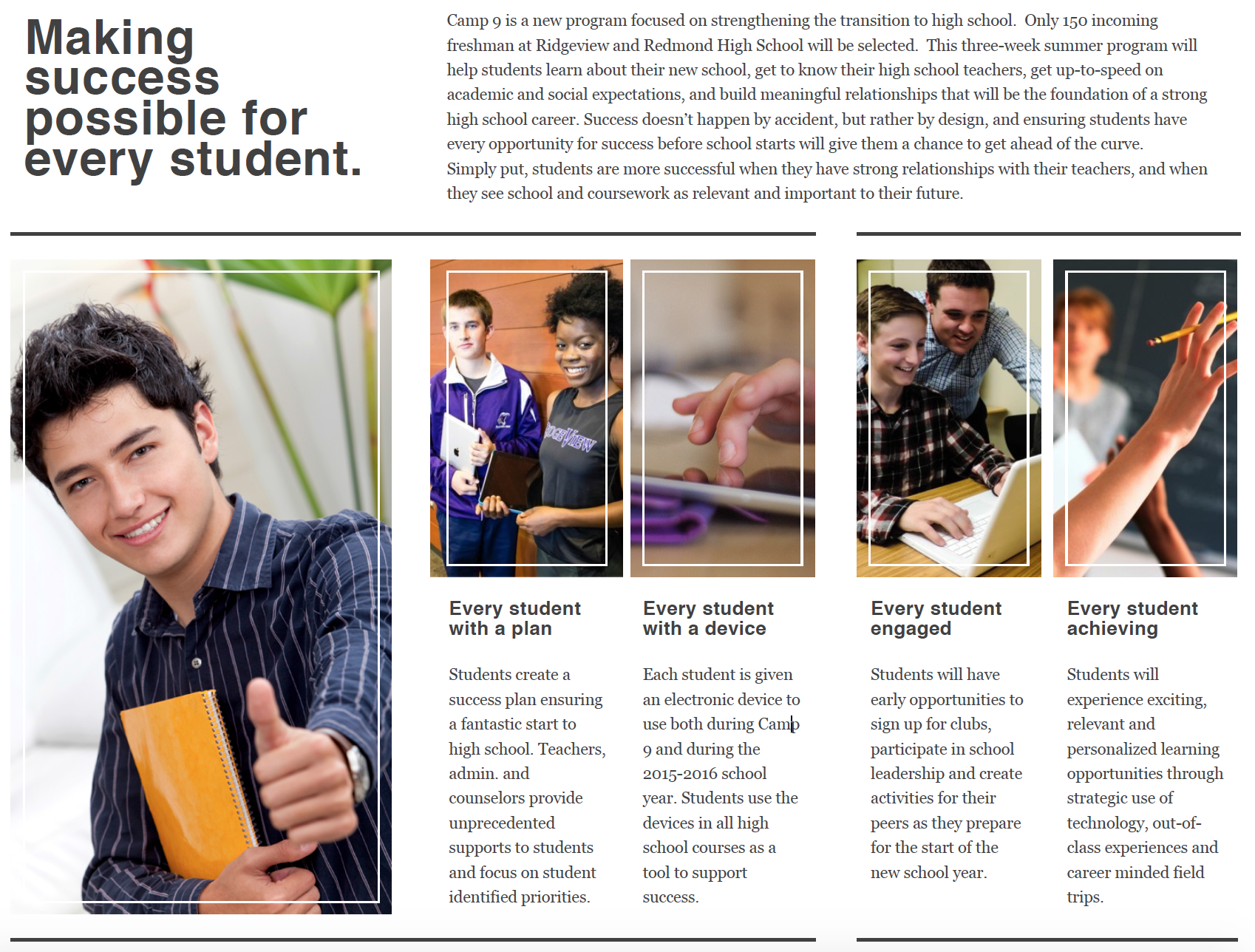
As such, Redmond School District is creating a summer bridge program to accelerate academic achievement, increase retention of previously taught concepts and skills and provide meaningful life experiences for students transitioning from eighth to ninth grade.